The Nine Hundred Golden Suns
The Nine Hundred Golden Suns is a sci-fi/space opera universe I've been writing in since 2017. I started off at the end, with Norah, Loren, and Casey's story as the Empire fell. I've since written the beginning (Euphi, Murah, Yuun, and Saia, in Imperial year 0), the expansion (Allustria and Coren; Saerion, Tarravin and Eliaene), the final expansion period (Mattrim, Eli, and Lhînir) and the end -- but also the end if the characters chose different paths (the Entwined series, with Anutéa, Loren, and Casilim-la).
The Imperial Portrait Gallery is my attempt to step through the history of this Empire, the face it wants to present to the world -- the portraits, the grandeur, the stability -- and the real stories behind those portraits.
The Imperial Portrait Gallery
Let's take a walk through the Imperial Portrait Gallery.
The hall stretches through the palace's western wing, its vaulted ceilings rising high enough to accommodate canvases that were meant to be seen from across vast ceremonial chambers. Consecra's eternal rain whispers against the reinforced windows that line one wall, casting the particular silver-grey light that has illuminated these portraits for twelve centuries. The other wall holds them: emperors and empresses, consorts and heirs, the accumulated faces of a dynasty that has outlasted wars and plagues and the slow erosion of time itself.
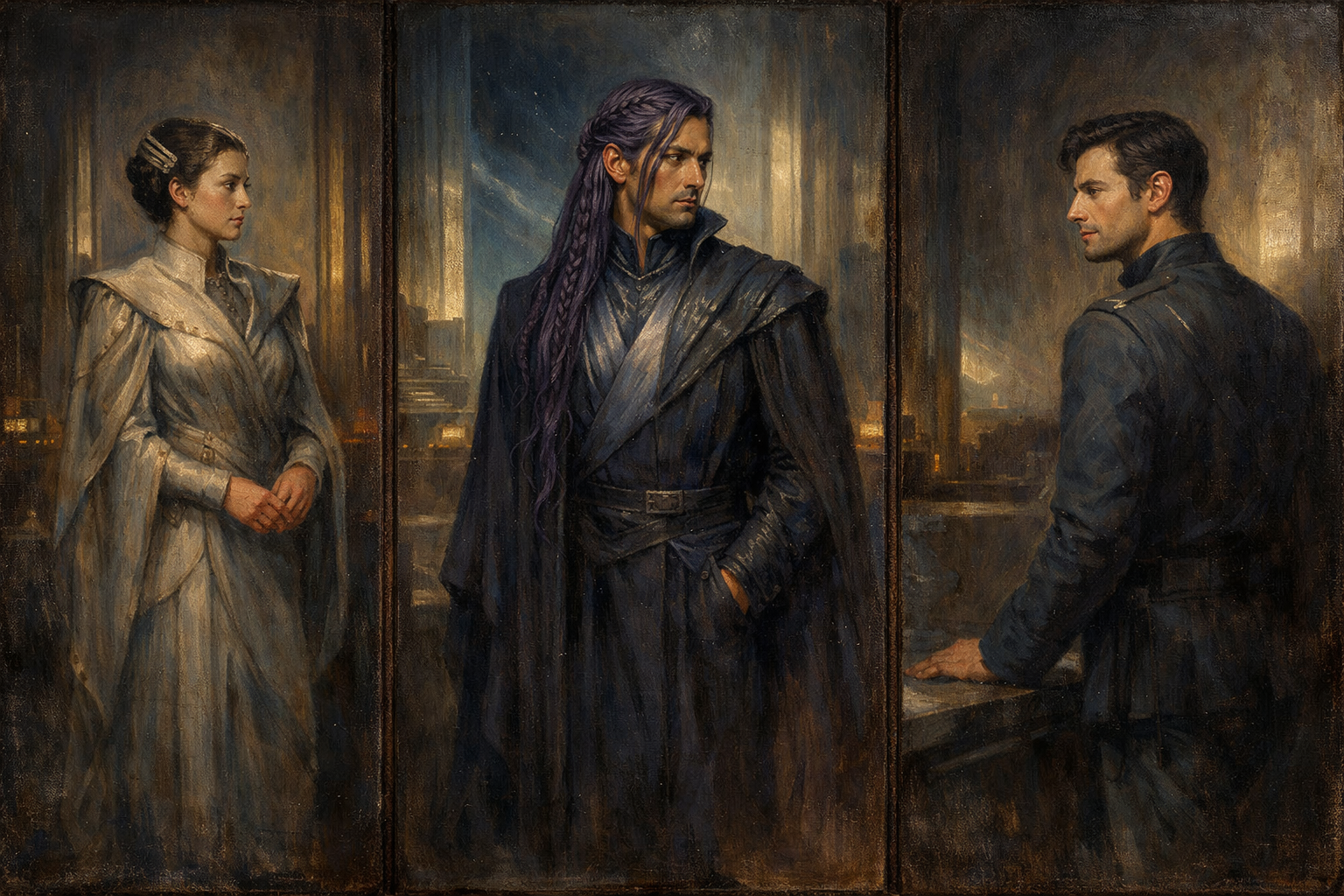 Twelve hundred years of imperial relationships, preserved in oil and light and the careful hands of artists who understood that their work would be scrutinised for centuries after their deaths.
The official guides will tell you about compositional techniques and colour palettes, about the evolution of court fashion and the symbolic language of ceremonial braids. They will point out which artists held the imperial appointment during which reigns, and how stylistic preferences shifted from the formal rigidity of the early period to the more naturalistic approaches of recent centuries.
What they will not tell you—what no official guide is permitted to acknowledge—is that these portraits are love letters and declarations of war, political manifestos and desperate confessions, frozen moments that capture truths their subjects may not have intended to reveal. The Imperial Portrait Gallery is not merely a record of who ruled and whom they married. It is a chronicle of desire and duty, of arrangements that became genuine and passions that had to be hidden, of the thousand ways that power shapes the heart and the heart shapes power in return.
Some of these relationships were straightforward: political alliances that remained precisely that, partnerships of convenience that never pretended to be anything more. Those portraits show their subjects with appropriate distance, appropriate composure, appropriate disinterest in one another.
Others were not straightforward at all.
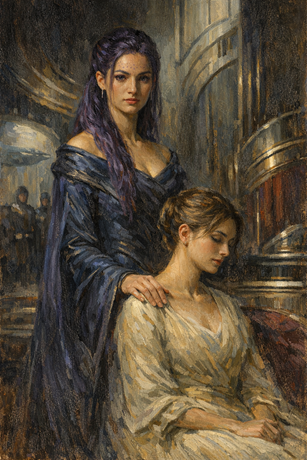 Here is Empress Euphi, who founded the dynasty twelve centuries ago, painted beside
Princess Saia—a marriage that began as pure self-indulgence
and became, if the portrait is to be believed, something far more tender.
Here is the infamous triptych of Emperor Kassaren with his official consort on one panel and his beloved general
on the other, the three canvases hung in sequence so that Kassaren's painted gaze falls forever upon
the man he was never permitted to formally acknowledge. Here is the small, easily overlooked portrait
of Empress Thyane as a young woman, before her reign, her hand resting on the shoulder of a
lady-in-waiting whose name was struck from court records after a scandal that historians are still
piecing together.
Here is Empress Euphi, who founded the dynasty twelve centuries ago, painted beside
Princess Saia—a marriage that began as pure self-indulgence
and became, if the portrait is to be believed, something far more tender.
Here is the infamous triptych of Emperor Kassaren with his official consort on one panel and his beloved general
on the other, the three canvases hung in sequence so that Kassaren's painted gaze falls forever upon
the man he was never permitted to formally acknowledge. Here is the small, easily overlooked portrait
of Empress Thyane as a young woman, before her reign, her hand resting on the shoulder of a
lady-in-waiting whose name was struck from court records after a scandal that historians are still
piecing together.
And here, at the gallery's far end where the most recent additions hang, is the portrait that visitors come from across the empire to see: Empress Anutéa, her official consort Casilim-la, and Lord Sewoytki arranged in a composition that defies centuries of precedent by acknowledging, openly and without diplomatic hedging, that imperial love need not limit itself to pairs.
Twelve hundred years. Hundreds of portraits. Countless relationships that ranged from cold alliance to consuming passion, from quiet contentment to spectacular disaster.
The rain continues its patient fall against the gallery windows, as it has since before the first of these portraits was painted, as it will continue long after the last viewer has walked these halls. The faces gaze down from their gilded frames, frozen in whatever truth the artist chose to capture, and the empire they built endures around them.
Let's take a walk. Let's see what they were willing to show us—and what they tried, and failed, to hide.
The Imperial Portrait Gallery
A visitor's guide to the collection — spanning twelve centuries of the Empire